

AdTech & Media
Why it matters
Search advertising familiarized marketers with granular intent, bids, measurable response, and rapid optimization. Display advertising historically offered broader reach but less control over who saw each impression and how quickly buying decisions could change.
RTB brought automated auctions and audience-level decisioning into display, making it possible to evaluate opportunities one impression at a time.
AdTech & Media
The central argument
The article explains how advertisers could segment audiences, use context and behavior, retarget interested users, control price, and access inventory without negotiating every placement directly. This also lowered some barriers for smaller advertisers seeking targeted reach.
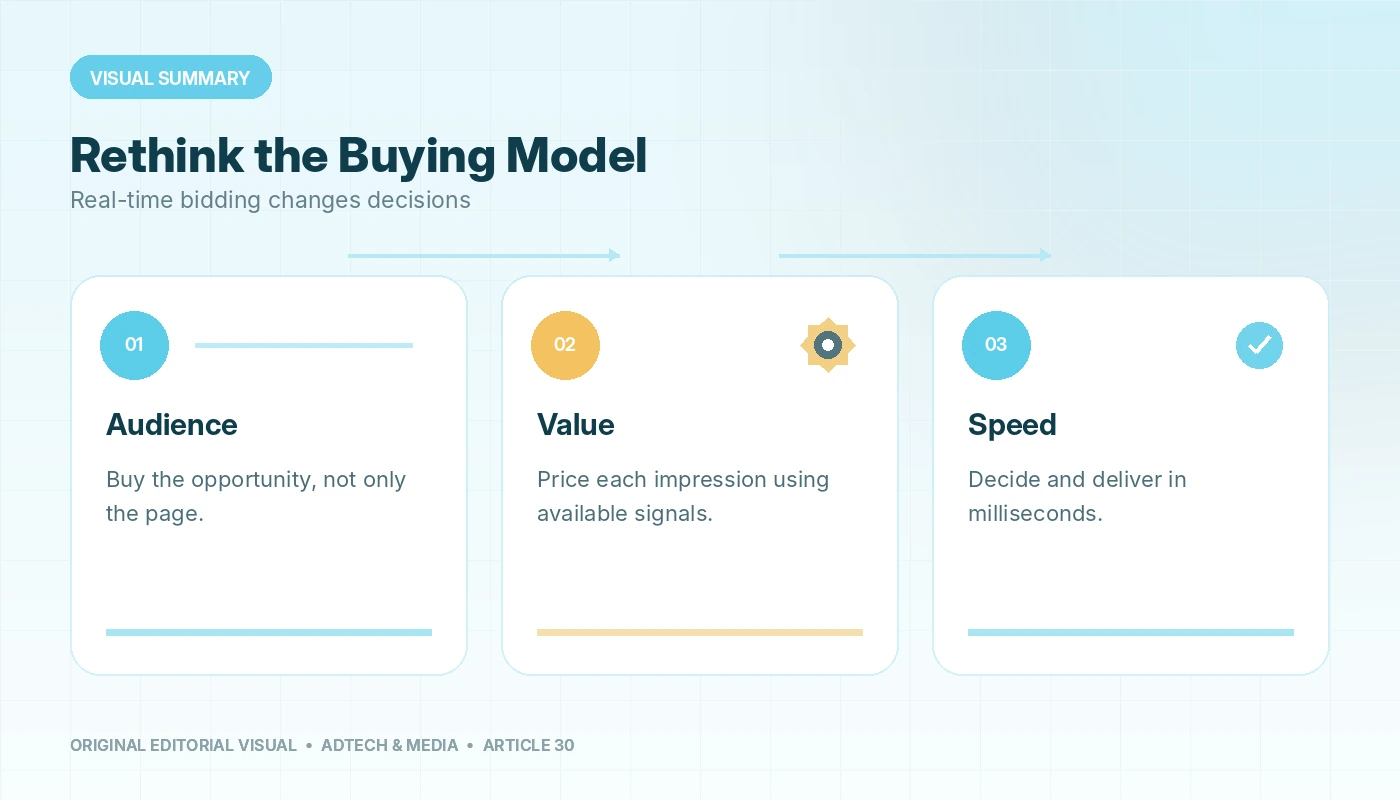
The mindset shift was from buying space to buying an opportunity to influence a defined audience. That opportunity still had to be evaluated for quality, relevance, frequency, and business value.
AdTech & Media
What to do in practice
- Begin with the audience decision and value of the impression, not the platform feature list.
- Use contextual and behavioral signals according to the strength and appropriateness of the data.
- Control frequency so retargeting remains useful rather than intrusive.
- Compare media cost with inventory quality and the likelihood of meaningful attention.
- Optimize toward business outcomes and understand the attribution limits of the data.
For each audience segment, document why it matters, what signal qualifies the user, what message fits, what bid range is reasonable, and what evidence will determine whether the strategy continues.
AdTech & Media
Closing perspective
RTB gave advertisers more control and feedback. The real change was not only technical; it was a shift toward continuous, evidence-based media decisions.