

AI & Transformation
Why it matters
A personal website looks like a straightforward project until design, content, navigation, responsiveness, search visibility, and deployment all collide. Using generative AI across that process quickly exposes the difference between producing code and producing a coherent product.
The useful lesson is not that AI can replace a designer or developer. It is that AI can make exploration faster—provided the human collaborator keeps testing assumptions, catches inconsistencies, and knows when a partial solution should be repaired or discarded.
AI & Transformation
The central argument
The article follows an iterative journey: beginning with a do-it-yourself approach, adding AI as an assistant, and eventually restarting parts of the build when accumulated compromises became harder to manage than a clean structure. Each phase sharpened the brief and made the next round of prompts more precise.
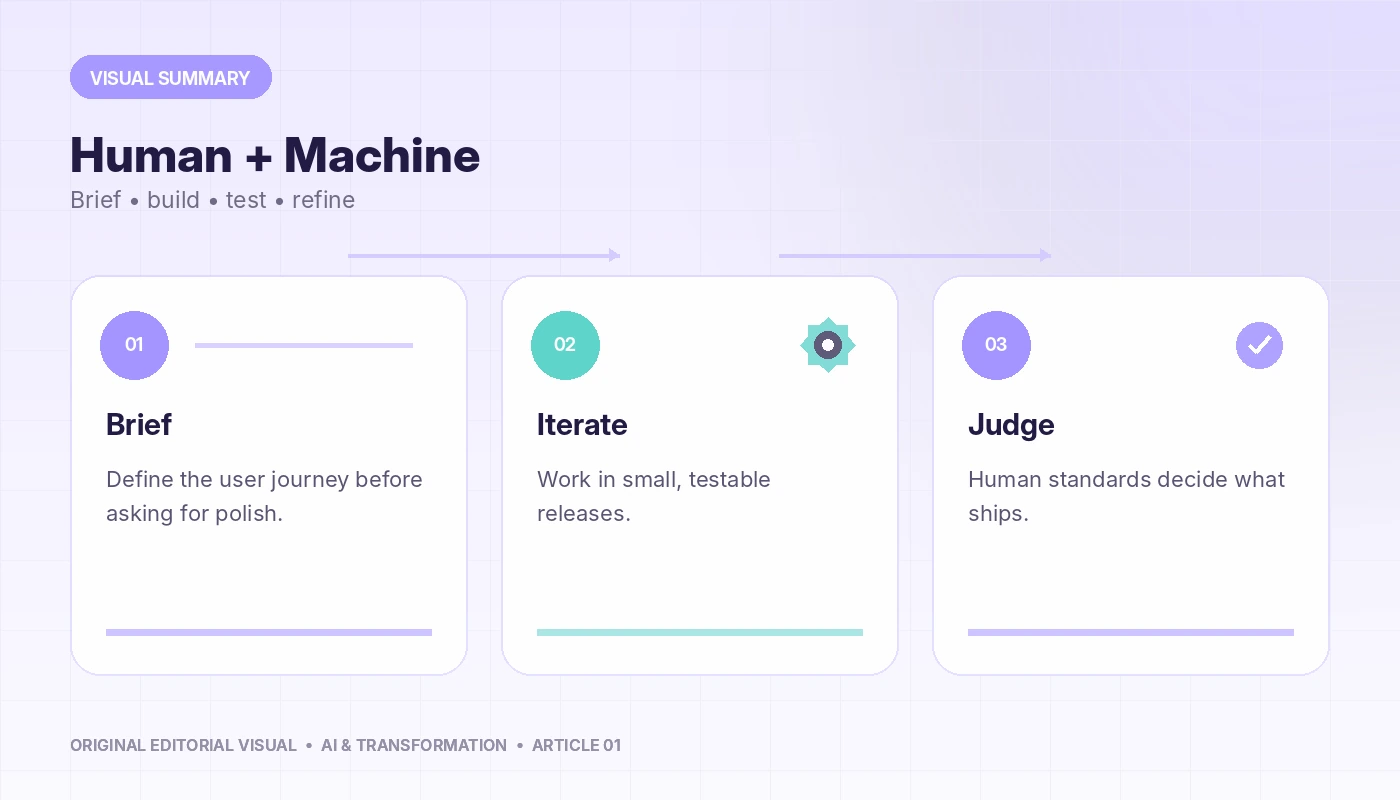
The central idea is simple: AI contributes speed and options; people contribute context, taste, accountability, and the ability to judge whether the result actually serves its audience. The quality of the collaboration depends less on a magical prompt than on disciplined feedback loops.
AI & Transformation
What to do in practice
- Start with the user journey and information architecture before asking for visual polish.
- Give AI narrow, testable tasks instead of asking it to solve the entire website at once.
- Review generated output for accessibility, mobile behavior, broken paths, and consistency—not only appearance.
- Treat a restart as a valid engineering decision when patching creates more complexity than rebuilding.
- Keep human ownership of the message, priorities, and definition of “done.”
A practical workflow is to work in small releases: define one outcome, generate or revise one component, test it in context, record what worked, and only then move forward. This keeps the human in control while still benefiting from AI’s speed.
AI & Transformation
Closing perspective
Human–machine collaboration works best when neither side is romanticized. AI is a capable accelerator, but the website becomes meaningful only through human intent, editorial judgment, and persistent refinement.