
AI & Transformation
Why it matters
Generative AI is often discussed through extremes: either as an inevitable replacement for knowledge work or as an unreliable novelty. Hands-on experimentation produces a more useful picture. The technology can compress research, drafting, ideation, and technical problem-solving, yet it can also create plausible mistakes and hidden rework.
Those contradictions are not edge cases. They are central to deciding where AI belongs in a workflow and where human review must remain non-negotiable.
AI & Transformation
The central argument
The article treats experimentation as a small laboratory. Different tools are tested against practical goals, and the outcome is evaluated not by how impressive the first response looks but by accuracy, repeatability, transparency, and the effort required to correct it.
The deeper questions are human: Who is accountable when an answer is wrong? Which skills weaken when people stop practicing them? How should teams preserve trust, originality, and learning while still taking advantage of automation?
AI & Transformation
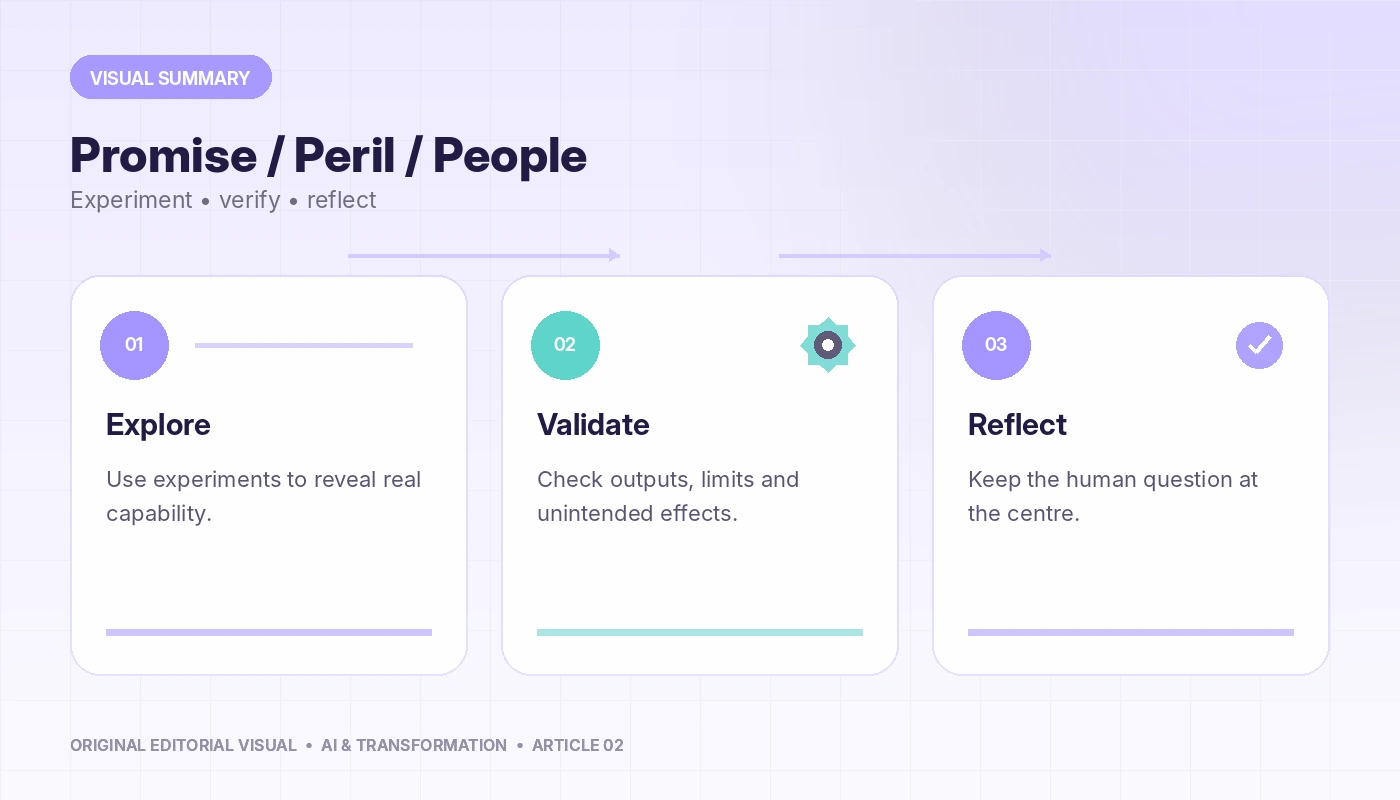
What to do in practice
- Use low-risk experiments to discover where AI creates measurable time or quality gains.
- Verify facts, calculations, citations, and technical claims before using generated material.
- Compare total effort—including checking and correction—not just generation speed.
- Protect sensitive information and understand what data a tool may retain.
- Keep curiosity and skepticism together; either one without the other produces poor decisions.
Teams can create an AI experiment log with the task, tool, prompt pattern, expected result, observed failure modes, review time, and final decision. Over time, this becomes a grounded operating guide rather than a collection of anecdotes.
AI & Transformation
Closing perspective
The promise of GenAI is real, but so is the need for judgment. The advantage will go to people who learn how to collaborate with the technology without surrendering responsibility to it.