

AdTech & Media
Why it matters
Ad operations is frequently treated as a downstream execution team: receive the order, traffic the campaign, monitor delivery, and resolve exceptions. That description misses its wider influence on revenue recognition, client confidence, inventory quality, product feedback, and renewal decisions.
When the function is managed only through queues and turnaround times, teams can become efficient at processing work while remaining disconnected from the commercial and customer consequences of that work.
AdTech & Media
The central argument
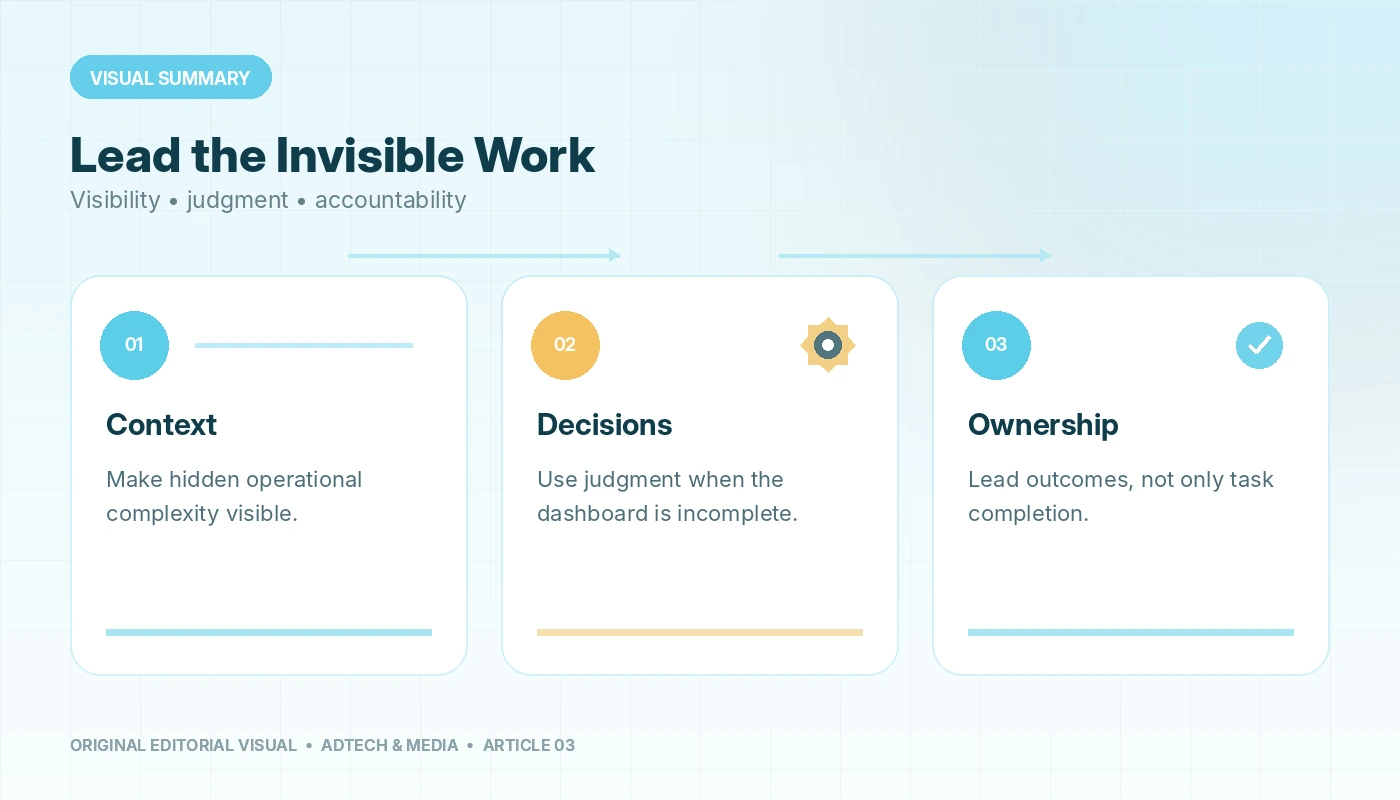
The article argues for leadership that translates business goals into operating priorities, gives specialists context, and makes trade-offs visible. Leaders must connect sales, product, finance, creative, data, and technology rather than allowing AdOps to absorb every gap in silence.
Leadership also means building systems that learn. Repeated campaign issues should generate product fixes, better briefing standards, automation opportunities, and clearer ownership—not merely heroic recovery by experienced operators.
AdTech & Media
What to do in practice
- Position AdOps metrics alongside revenue, retention, quality, and customer-impact measures.
- Give teams the commercial context behind priority campaigns and client commitments.
- Create explicit escalation paths so risk is surfaced early rather than hidden until delivery fails.
- Convert recurring manual fixes into process, product, or automation improvements.
- Develop operators into decision-makers who can challenge weak inputs and recommend better solutions.
A useful leadership review combines delivery health with root causes: what is at risk, why it is at risk, who owns the constraint, what decision is needed, and what permanent improvement will prevent recurrence.
AdTech & Media
Closing perspective
Ad operations is the unseen hand that turns media strategy into delivered value. Treating it as a leadership function strengthens both execution and the business built on top of it.