
AI & Transformation
Why it matters
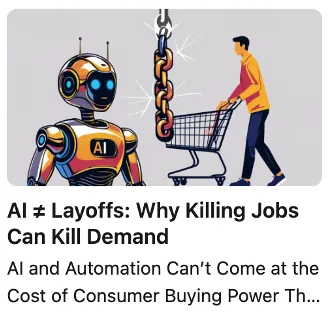
Announcements about AI and workforce reductions are often presented as if the two are naturally identical. That framing treats labor only as a cost and overlooks its other roles: people carry institutional knowledge, improve services, create products, solve exceptions, and participate in the demand that keeps markets moving.
A narrow automation decision can therefore create wider costs through weaker customer experience, lower morale, loss of capability, and reduced spending power.
AI & Transformation
The central argument
The article separates productivity from displacement. AI can remove repetitive work and increase output, but leaders still choose whether the gain becomes better service, new capacity, lower prices, higher margins, reduced employment, or some combination of these outcomes.
Sustainable transformation asks where people can be redeployed, what new work becomes possible, and how value should be shared. The goal is not to preserve every task; it is to avoid destroying useful capability and demand while chasing a simplistic efficiency story.
AI & Transformation
What to do in practice
- Map tasks before roles; many jobs contain both automatable work and high-value human judgment.
- Include customer, revenue, risk, and knowledge impacts in the automation business case.
- Invest in redeployment and reskilling before assuming reduction is the only path to savings.
- Track whether productivity gains improve price, service, innovation, or employee capacity.
- Communicate decisions honestly so uncertainty does not become organizational paralysis.
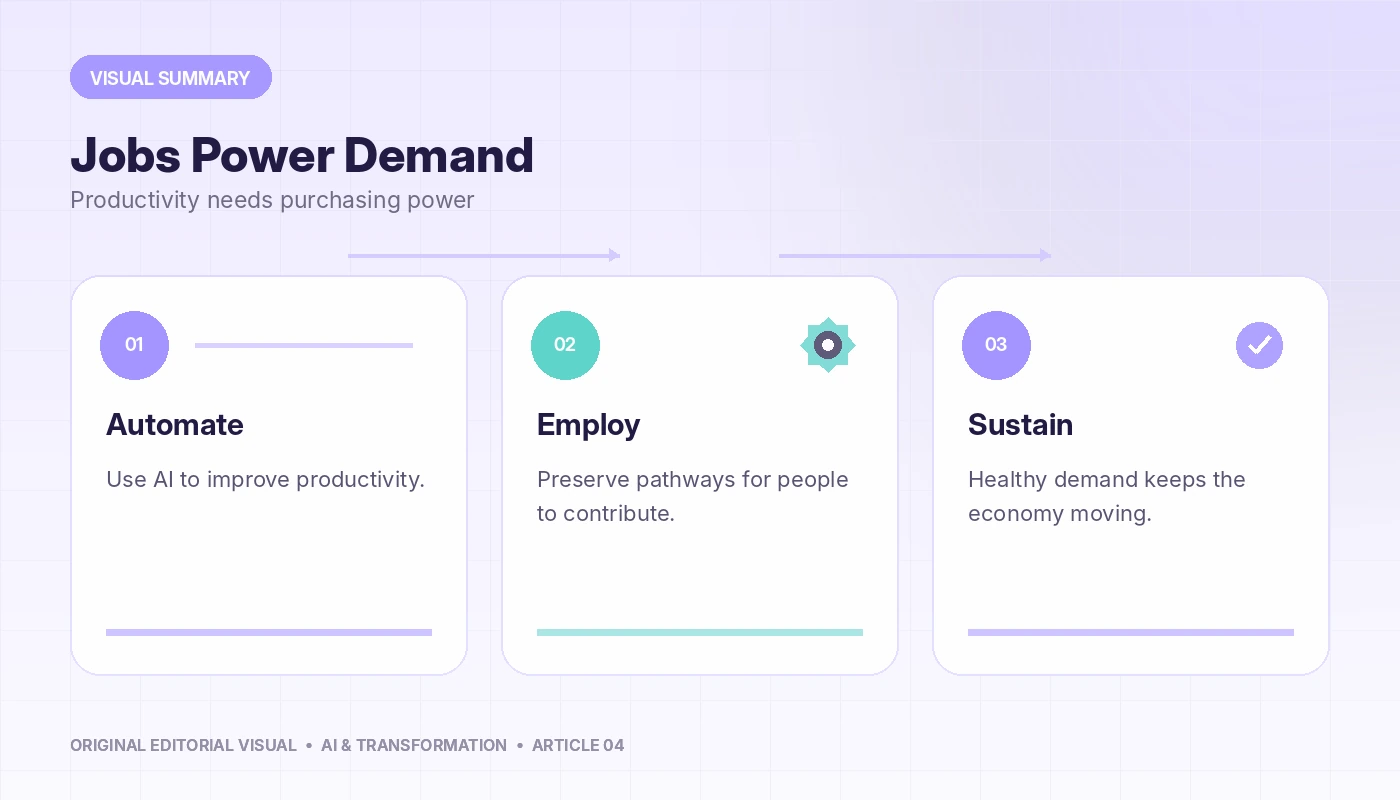
Before approving an AI-led restructuring, leaders can compare three scenarios: automate and reduce, automate and redeploy, or automate and grow. Testing each against a multi-year view often reveals value that a single cost target misses.
AI & Transformation
Closing perspective
AI is a tool for redesigning work. Whether that redesign strengthens or weakens the economy depends on the choices leaders make around people, capability, and demand.