

Leadership & Careers
Why it matters
Online platforms make it easy to submit many applications in a short time. Under pressure, candidates may treat every vacancy with a familiar title as equally suitable, even when the responsibilities, seniority, location, or required experience differ substantially.
Recruiters and hiring managers then see generic material that does not explain why the person wants this role or how their experience meets its specific needs.
Leadership & Careers
The central argument
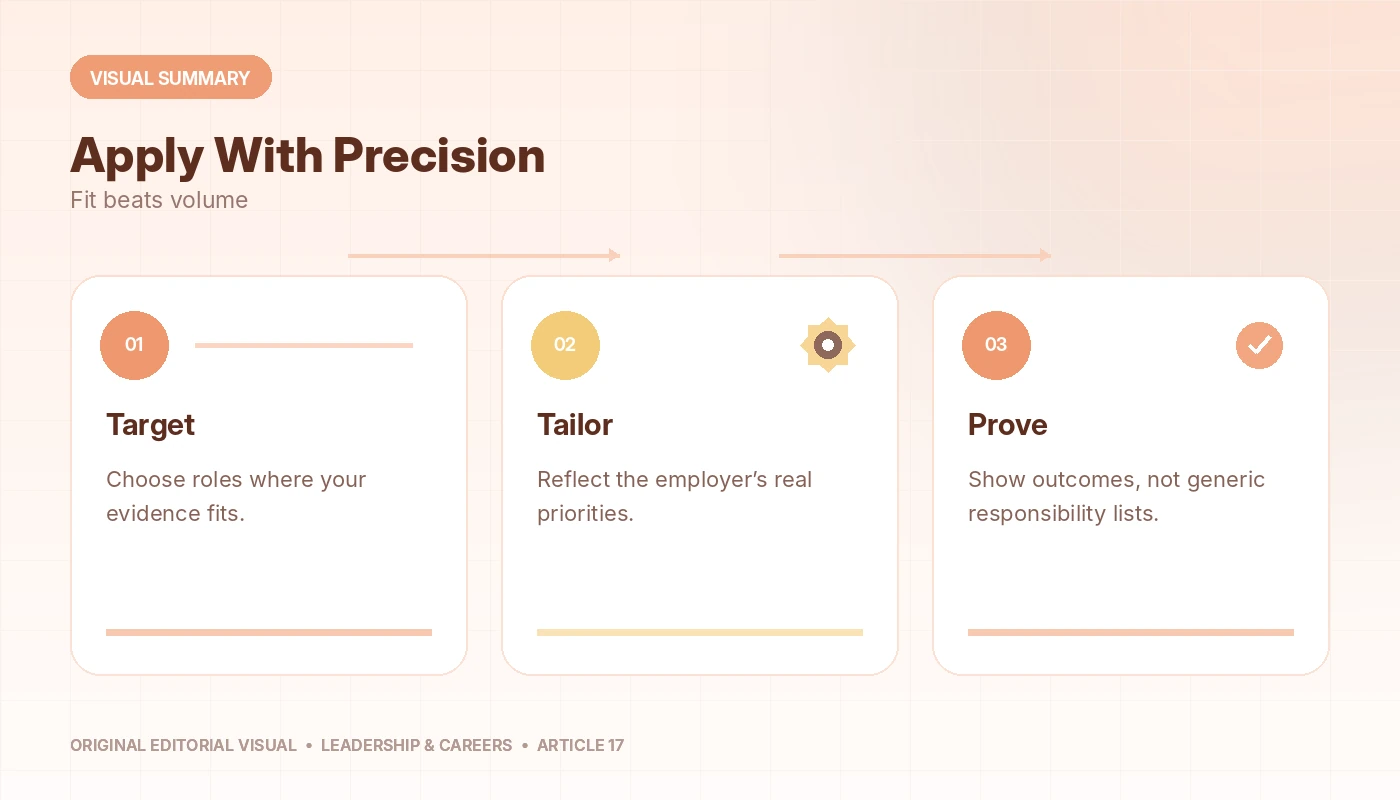
The article argues for quality over volume. A focused application begins with understanding the company, the actual problem behind the vacancy, and the evidence that shows the candidate can contribute.
Selectivity also protects credibility. Repeatedly applying to unrelated roles can make it harder for an employer to understand the candidate’s direction and may waste energy that could be spent on networking, preparation, and stronger applications.
Leadership & Careers
What to do in practice
- Define the role families, level, geography, and conditions that genuinely fit your goals.
- Read the responsibilities and success measures—not only the title.
- Apply when you can demonstrate meaningful evidence for the core requirements.
- Tailor the opening summary and examples to the employer’s likely problem.
- Track applications and learn from response patterns rather than increasing volume blindly.
Use a simple scorecard before applying: role fit, capability evidence, motivation, constraints, and access to a meaningful connection. Spend more time on high-scoring opportunities and decline the rest without guilt.
Leadership & Careers
Closing perspective
A job search is not won by the number of buttons clicked. It is won by making a clear, credible match between a real need and the value you can bring.