

AdTech & Media
Why it matters
Programmatic advertising produces large volumes of fast-moving signals: audiences, bids, placements, creative variants, delivery patterns, conversions, and fraud indicators. Human teams cannot manually evaluate every combination at market speed.
AI can help identify patterns and adjust decisions continuously, but the value depends on data quality, objective design, measurement discipline, and safeguards against opaque or biased outcomes.
AdTech & Media
The central argument
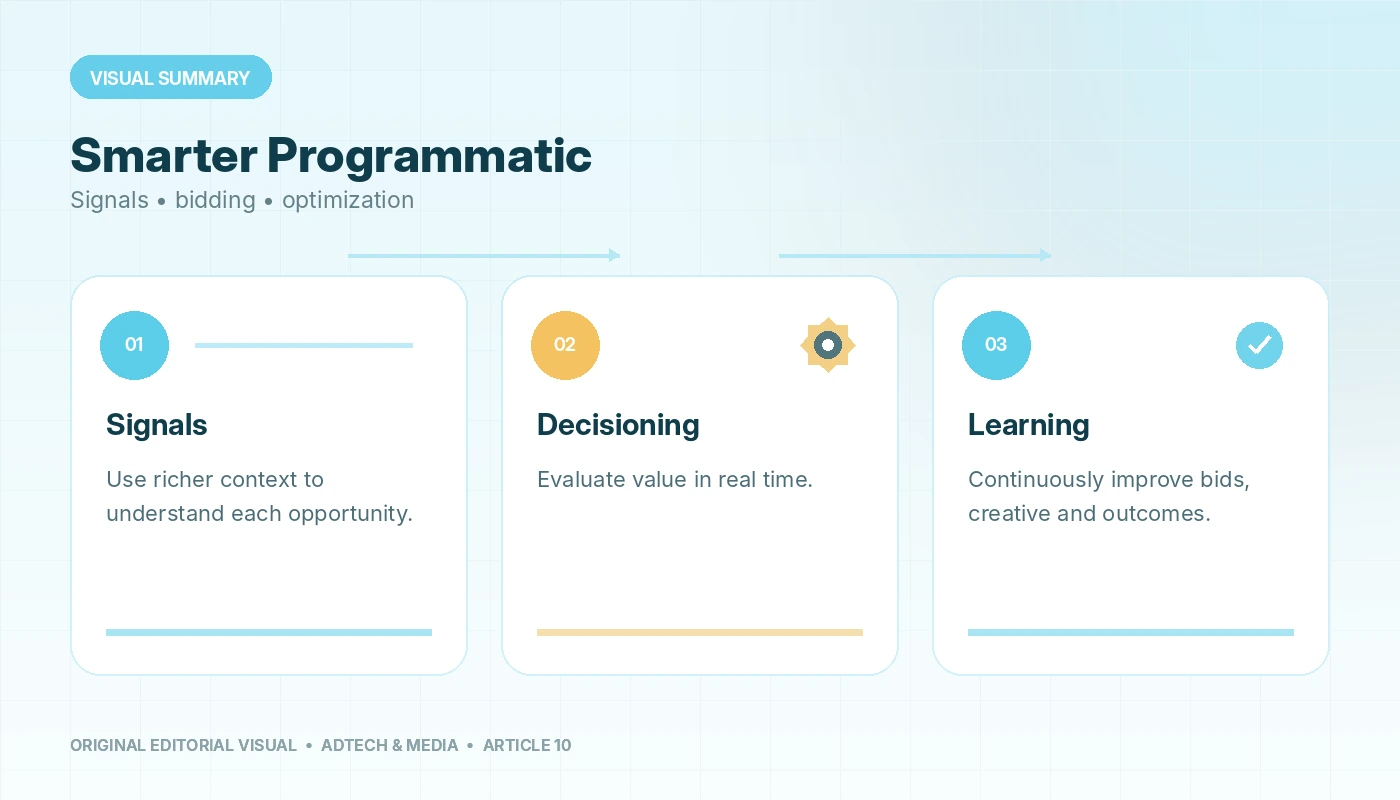
The article explores AI across several layers: real-time optimization, audience and creative personalization, anomaly and fraud detection, predictive pacing, attribution support, and workflow automation for campaign teams.
The central argument is that automation should be linked to a clear commercial objective. A system that optimizes the wrong proxy can become very efficient at producing the wrong business result.
AdTech & Media
What to do in practice
- Define the business outcome and guardrails before selecting an optimization signal.
- Feed models clean, timely, consent-aware data and monitor drift in performance.
- Use AI to prioritize anomalies and opportunities while keeping humans responsible for high-impact decisions.
- Test creative and audience changes with controlled experiments rather than accepting black-box lift claims.
- Pair fraud detection with supply-path transparency and ongoing inventory quality review.
Start with one bounded use case—such as pacing risk or creative fatigue—where the current baseline is known. Compare model recommendations with human decisions, record exceptions, and scale only after the learning loop is reliable.
AdTech & Media
Closing perspective
AI can make programmatic advertising more adaptive and precise, but durable advantage comes from combining machine speed with transparent objectives, high-quality data, and accountable operators.