
AI & Transformation
Why it matters
Campaign teams coordinate briefs, content variants, approvals, audience inputs, channel setup, reporting, and stakeholder requests. Much of that work is necessary but does not require the same level of creativity or judgment at every step.
Generative AI can draft, summarize, classify, transform, and retrieve information quickly. Used carelessly, it can also create off-brand content, unreliable claims, duplicated ideas, and new review burdens.
AI & Transformation
The central argument
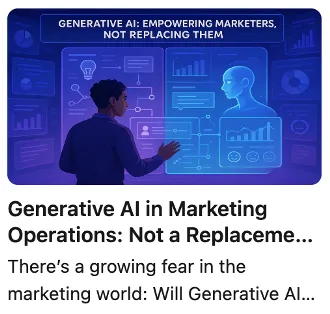
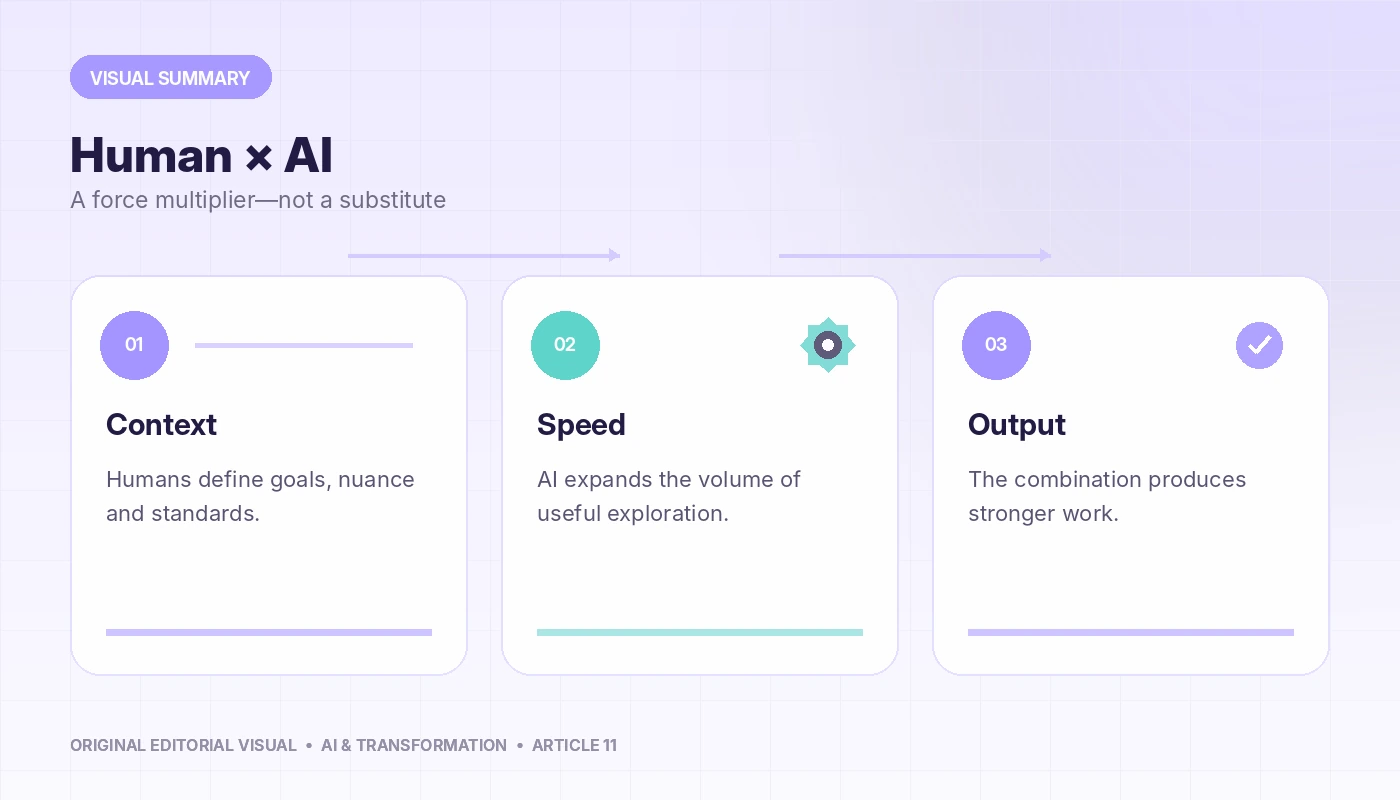
The article rejects the replacement narrative and instead positions GenAI as a force multiplier. The strongest model pairs machine assistance with people who provide customer context, creative direction, ethical judgment, and final accountability.
The result should be more time for strategy, experimentation, relationship-building, and learning—not simply a higher volume of mediocre output.
AI & Transformation
What to do in practice
- Apply GenAI first to repetitive drafting, summarization, variation, and knowledge retrieval.
- Create brand, legal, privacy, and factual-review checkpoints for generated content.
- Measure whether released capacity moves into higher-value work rather than disappearing into more volume.
- Train marketers to write clear briefs, evaluate output, and understand model limitations.
- Maintain approved source material so generated work is grounded in current, trusted information.
Build a “human–AI–human” workflow: a person frames the objective and constraints, AI produces options or analysis, and a qualified person selects, edits, verifies, and approves the result.
AI & Transformation
Closing perspective
The future of marketing operations is hybrid. Teams that combine automation with sharper human judgment will move faster without giving up trust or differentiation.