
AI & Transformation
Why it matters
Marketing operations sits at the intersection of data, process, content, technology, and revenue teams. Because the work is cross-functional, isolated AI pilots can generate local speed while creating inconsistency or risk elsewhere.
A transformation view considers the full chain: how work enters, where knowledge lives, what decisions repeat, how outputs are reviewed, and how customer signals return to planning.
AI & Transformation
The central argument
The article surveys applications across workflow automation, personalization, content production, predictive analysis, lead management, reporting, and internal support. It also emphasizes the governance required for privacy, bias, accuracy, intellectual property, and brand integrity.
The operating implication is that tools alone are not the transformation. Teams need redesigned roles, approved data and content sources, review rules, capability building, and measures tied to business outcomes.
AI & Transformation
What to do in practice
- Prioritize use cases by value, feasibility, data readiness, and risk—not novelty.
- Redesign the end-to-end workflow so AI output has a clear owner and review path.
- Connect personalization to consent, relevance, and customer value rather than volume alone.
- Use predictive signals as decision support and monitor performance against real outcomes.
- Build an adoption roadmap that includes skills, governance, integration, and change management.
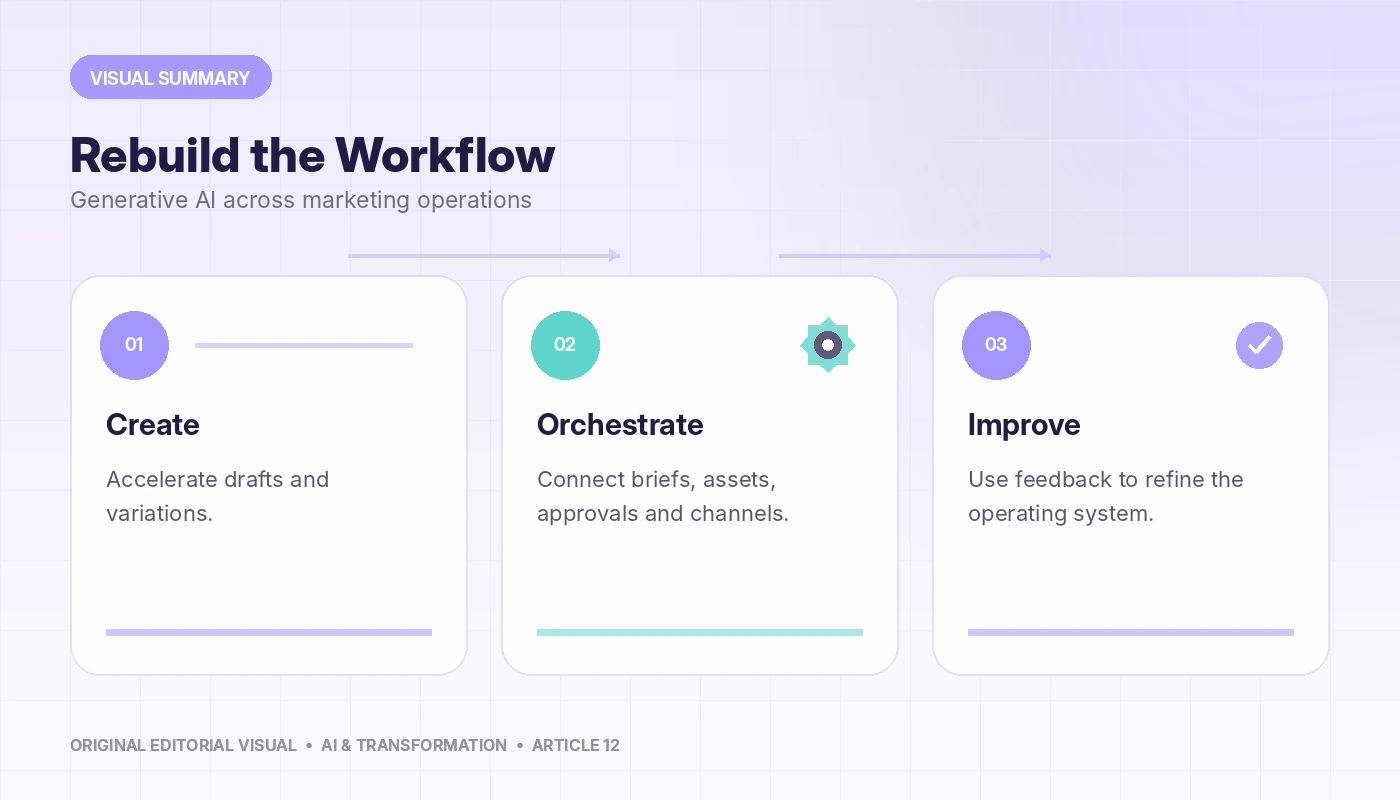
A useful roadmap begins with workflow discovery, selects a small portfolio of use cases, defines guardrails, tests with users, and then scales through reusable platforms and standards rather than separate experiments in every team.
AI & Transformation
Closing perspective
Generative AI can transform marketing operations, but the durable gain comes from an operating system that joins technology, people, process, and responsible decision-making.