
AdTech & Media
Why it matters
Operators translate media plans and creative assets into platform configurations, validate countless details, monitor delivery, explain performance, and respond to exceptions. The work rewards precision but is frequently interrupted by incomplete inputs and urgent requests.
Generative AI can reduce time spent interpreting instructions, preparing checks, summarizing performance, and answering common questions. It cannot be trusted to execute without controls simply because the language it produces sounds confident.
AdTech & Media
The central argument
The article identifies practical applications such as automated briefing checks, trafficking assistance, creative and landing-page QA, anomaly explanations, reporting narratives, training support, and draft client responses.
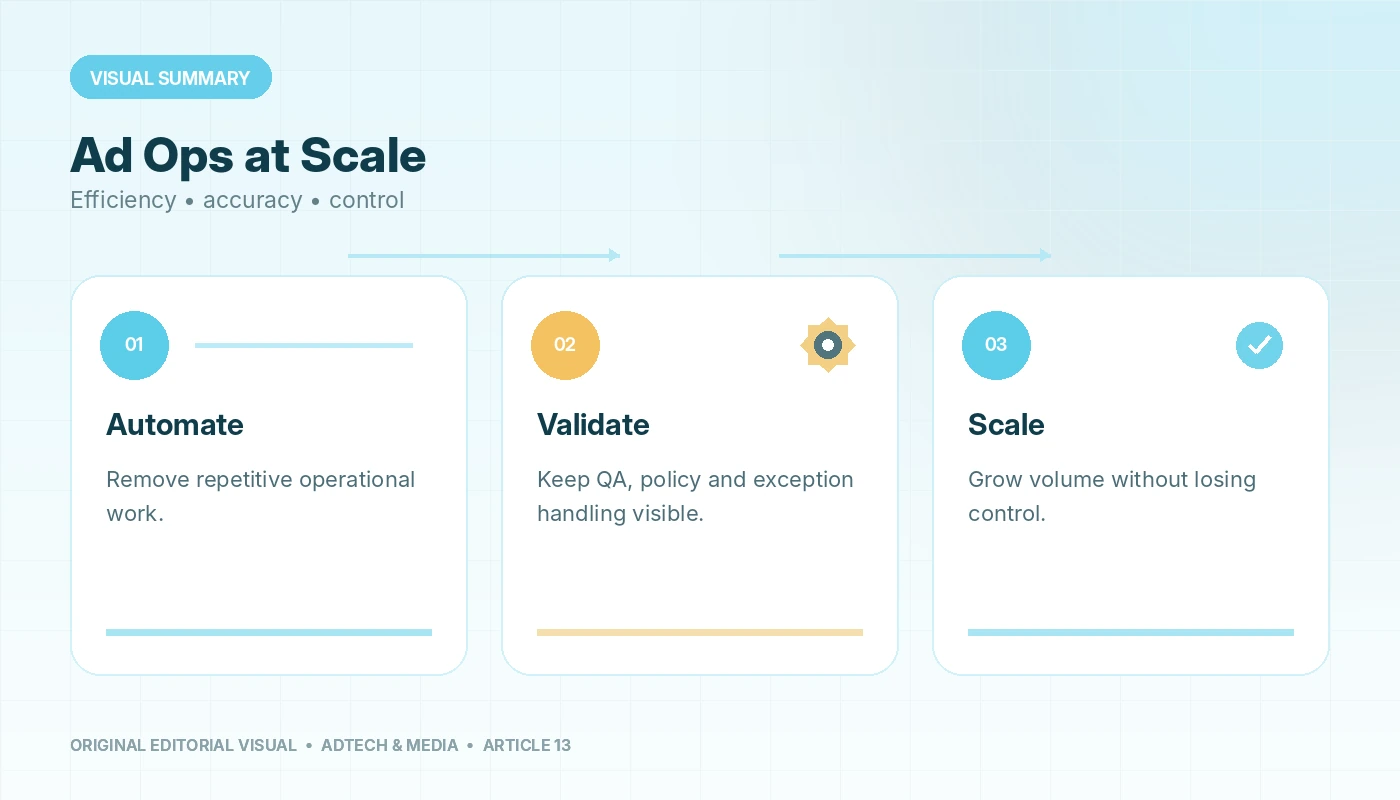
The best operating model keeps a person accountable for launch-critical decisions. AI proposes, highlights, or drafts; the operator verifies against the source of truth and approves the action.
AdTech & Media
What to do in practice
- Use structured campaign inputs so AI does not have to infer critical requirements from ambiguous messages.
- Automate checklists and exception highlighting before automating final platform changes.
- Ground reporting summaries in approved data and link every claim to a traceable metric.
- Capture operator corrections so prompts, rules, and knowledge bases improve over time.
- Separate low-risk assistance from high-risk actions that require explicit human approval.
Begin with shadow mode: let the AI review or draft alongside the existing process without controlling production. Compare misses, false alarms, review time, and operator confidence before introducing deeper automation.
AdTech & Media
Closing perspective
GenAI can make AdOps faster, more consistent, and easier to scale. Its value is highest when precision, auditability, and human responsibility remain part of the design.