

AdTech & Media
Why it matters
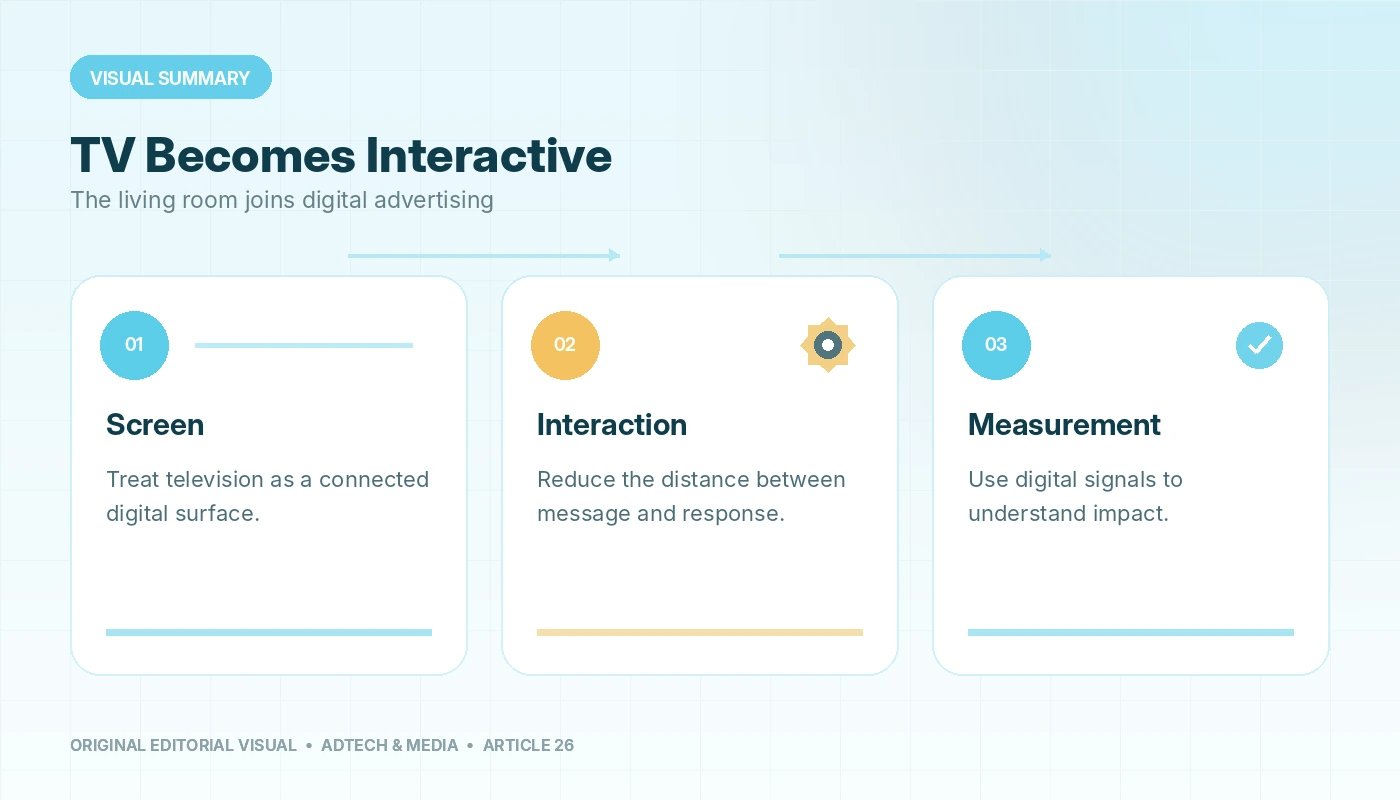
Traditional television brought sight, sound, motion, and shared household attention, but offered limited individual targeting and delayed measurement. Digital advertising brought data, interaction, and rapid optimization, usually on smaller personal screens.
Connected devices such as Apple TV suggested a convergence: premium video experiences delivered through software, accounts, applications, and networked devices.
AdTech & Media
The central argument
The article explores how a connected television platform could create new choices for advertisers through addressability, app-based experiences, cross-device journeys, richer measurement, and more flexible creative formats.
It also implies a shift in power toward the platforms that control the operating environment, identity layer, distribution, and user interface. The value is not only the screen; it is the data and decision layer around the screen.
AdTech & Media
What to do in practice
- Design for the living-room context rather than repurposing desktop or mobile creative unchanged.
- Connect exposure to cross-device journeys without assuming perfect identity resolution.
- Balance targeting and measurement with clear privacy expectations.
- Consider how platform rules and distribution access shape advertiser opportunity.
- Evaluate success through brand and business outcomes, not only interaction.
For connected-TV experiments, define the household moment, the role of the large screen, the next desired action, and how that action can be measured across devices without creating unnecessary friction.
AdTech & Media
Closing perspective
Connected television changes advertising when it combines the emotional power of TV with the intelligence and flexibility of digital—while respecting the context in which people watch.