
Operations & Strategy
Why it matters
A new role often comes with a visible mandate to transform performance. Yet the organization has a history, informal networks, competing incentives, and earlier change attempts that shape how any new proposal will be received.
A framework helps a leader move from urgency to disciplined execution without skipping the human work required for adoption.
Operations & Strategy
The central argument
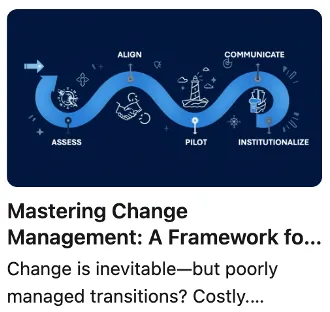
The article organizes change into five connected stages: assess the current system, form a coalition, pilot the new approach, communicate evidence and decisions, and institutionalize what works. Each stage reduces a different source of risk.
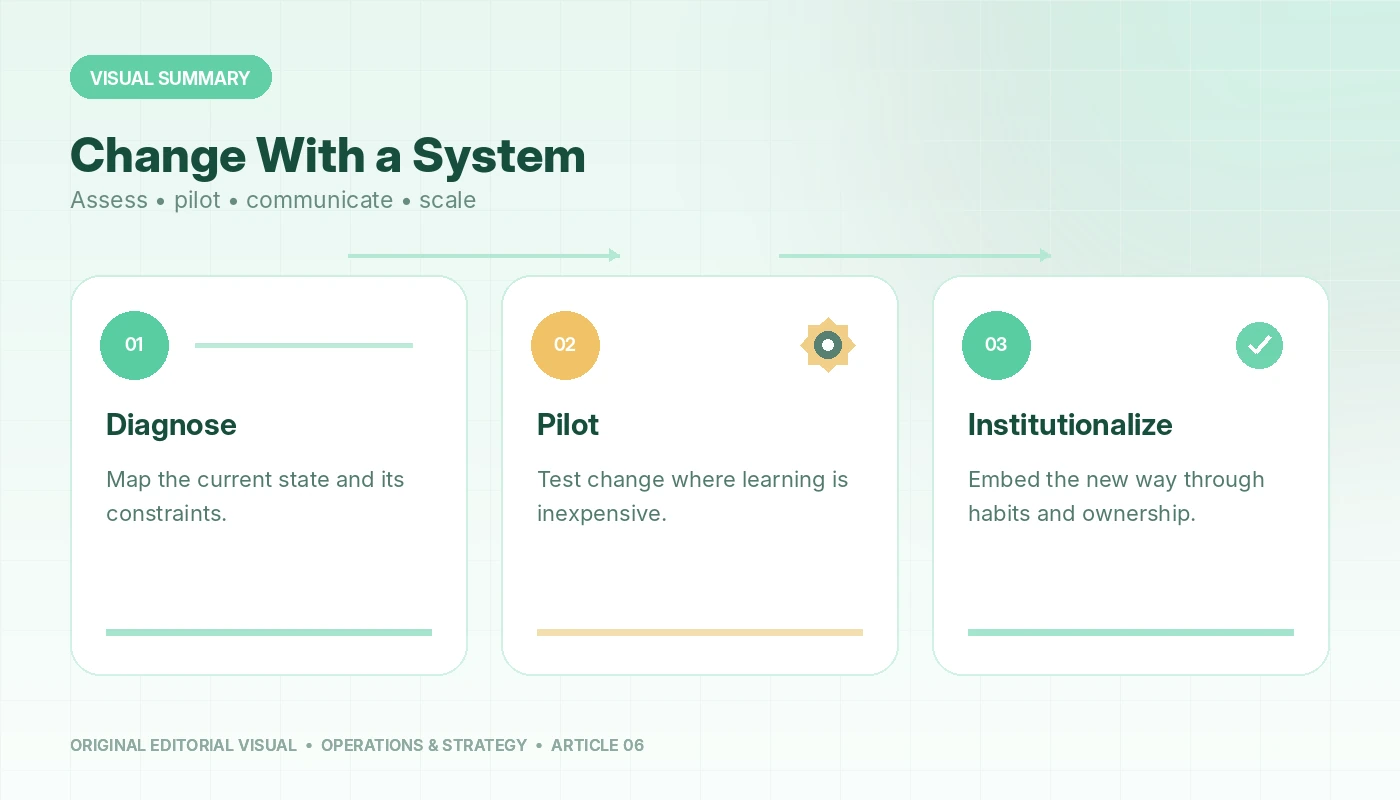
Assessment prevents solution-first thinking. Coalition building creates ownership. Pilots turn debate into learning. Communication makes trade-offs visible. Institutionalization aligns measures, roles, routines, and reinforcement with the desired behavior.
Operations & Strategy
What to do in practice
- Diagnose process, capability, incentives, technology, and culture before naming the solution.
- Build a coalition that includes respected operators, not only senior sponsors.
- Pilot in a bounded area with clear measures and a plan for learning from failure.
- Communicate what is changing, what is not changing, and why the sequence matters.
- Embed successful change into goals, governance, training, and management routines.
Use the first 90 days to move from listening to a controlled pilot rather than to enterprise-wide rollout. A documented baseline and a small body of evidence make later scaling faster and more credible.
Operations & Strategy
Closing perspective
Change management is not a presentation layer around transformation. It is the operating discipline that turns an idea into repeatable behavior.