
Operations & Strategy
Why it matters
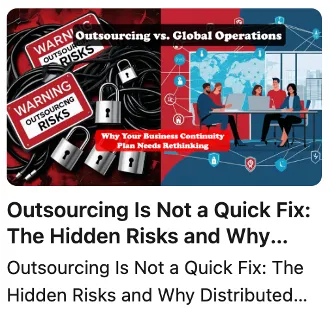
Organizations sometimes outsource under pressure: service levels are slipping, costs are rising, or internal teams cannot scale. In that moment, a vendor contract can look like an immediate solution. The risk is that unresolved design problems are simply moved across an organizational boundary.
The consequences may include loss of operational visibility, security and access concerns, dependence on a vendor’s staffing model, and a mismatch between transactional delivery and the company’s long-term capability needs.
Operations & Strategy
The central argument
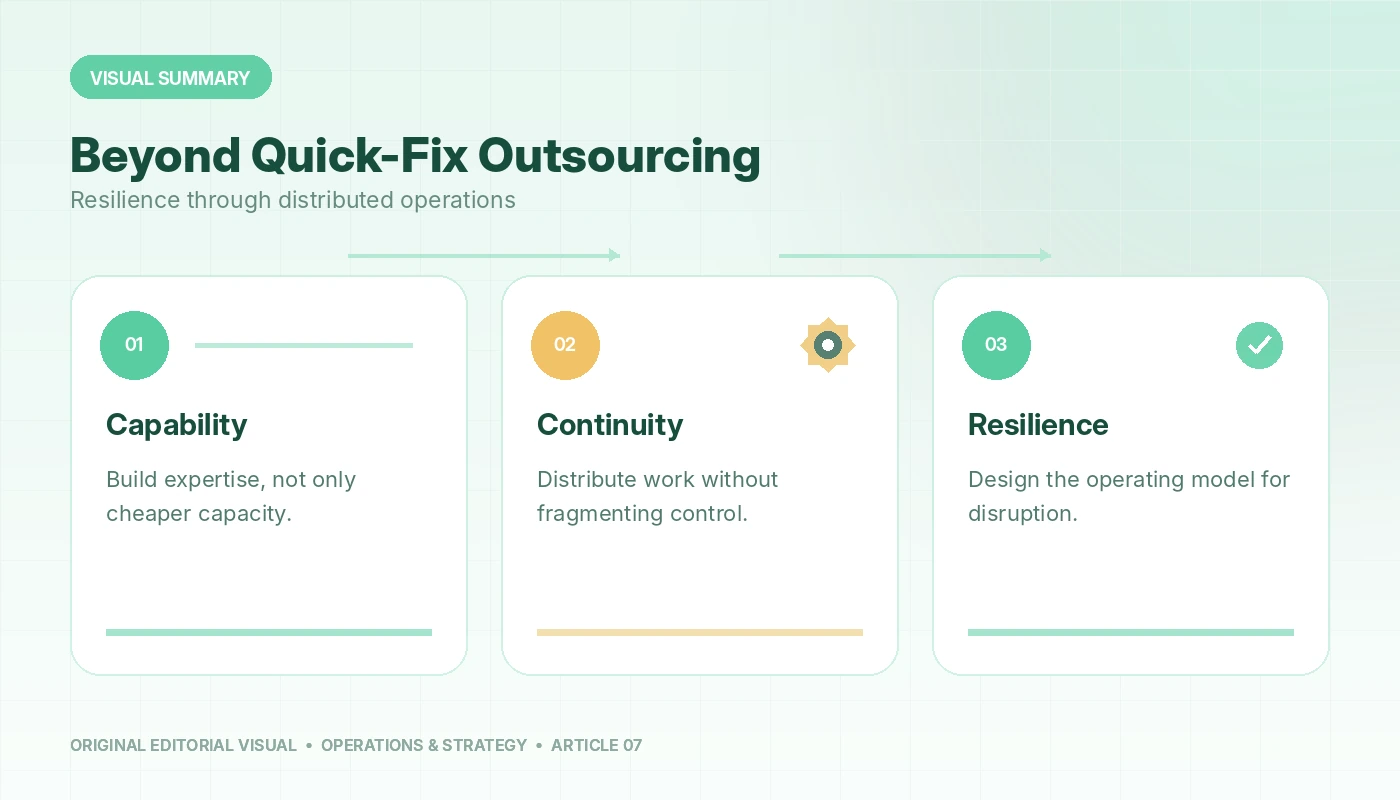
The article argues that accountability for outcomes remains with the client. A sustainable model therefore needs retained process knowledge, clear decision rights, strong data controls, shared measures, and an operating cadence that exposes risk early.
It also presents distributed global operations as an alternative: talent can be placed across locations and time zones while governance, standards, and strategic ownership remain closely integrated with the business.
Operations & Strategy
What to do in practice
- Fix ambiguous workflows and ownership before transferring them to another organization.
- Retain enough domain expertise to challenge performance and redesign the service.
- Define security, access, continuity, and exit requirements in operational—not only legal—terms.
- Measure outcomes and improvement, not just headcount, utilization, or ticket closure.
- Design geographic distribution around resilience and talent, not only labor arbitrage.
Before outsourcing, run a readiness review covering process stability, documentation, volume variability, risk, internal capability, governance cost, and transition complexity. A “no-go” finding can save far more than a rushed contract.
Operations & Strategy
Closing perspective
Outsourcing is a delivery choice, not a substitute for operating design. The strongest global models combine access to talent with retained accountability and transparent governance.