
Operations & Strategy
Why it matters
Many managed-services relationships begin with a clear operational promise: stabilize delivery, provide specialist capacity, and improve cost predictability. Over time, that promise can become a ceiling if the provider is measured only on keeping the lights on.
Clients increasingly expect partners to identify patterns, anticipate risk, simplify processes, introduce automation, and connect day-to-day execution with business priorities.
Operations & Strategy
The central argument
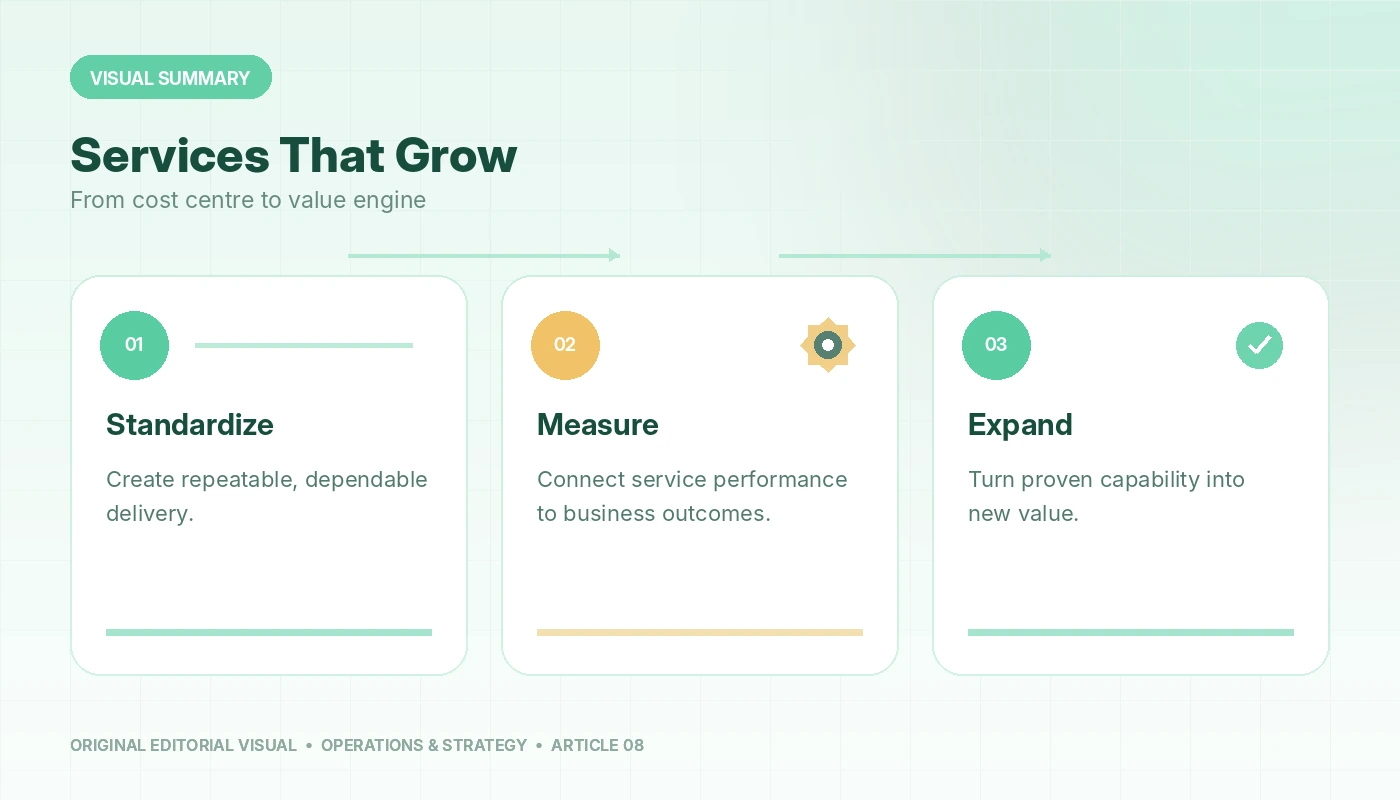
The article describes a progression from reactive service delivery to a growth-oriented partnership. The shift begins with alignment on business outcomes and continues through proactive analytics, scalable automation, stronger skills, and a shared improvement roadmap.
Growth does not mean turning every service conversation into a sales pitch. It means using operational proximity to reveal opportunities that improve retention, customer value, product quality, data, or market responsiveness.
Operations & Strategy
What to do in practice
- Translate service-level measures into the business outcomes they protect or improve.
- Use operational data to predict issues and recommend action before clients escalate them.
- Automate repetitive work while reinvesting capacity in analysis, innovation, and advisory support.
- Build domain and communication skills so teams can explain implications, not only activity.
- Maintain a joint roadmap with benefits, owners, dependencies, and adoption measures.
Add a quarterly value review beside the operational review. It should show improvements delivered, risks avoided, insight generated, capacity released, and the next set of jointly prioritized opportunities.
Operations & Strategy
Closing perspective
Reliability earns permission to stay; continuous value creation earns permission to grow. Managed services can do both when operations are connected to the client’s strategy.