

Leadership & Careers
Why it matters
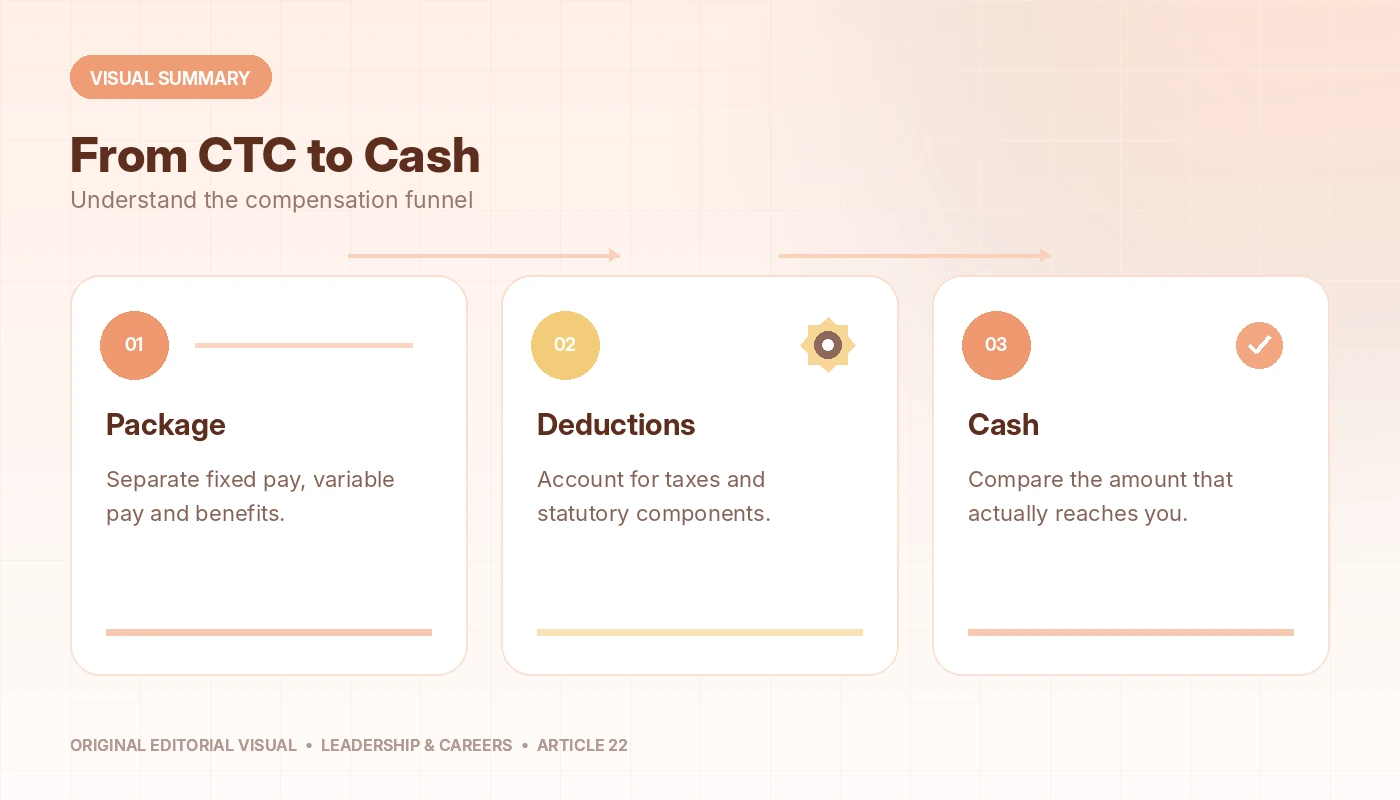
Cost to company, or CTC, is designed to represent the employer’s total annual cost associated with an employee. It may include fixed salary, variable pay, retirement contributions, insurance, allowances, and other benefits. Not every component arrives as cash in the employee’s bank account each month.
Take-home pay is the amount available after payroll deductions and after excluding benefits or variable elements that are not paid monthly.
Leadership & Careers
The central argument
The article encourages candidates to move beyond the headline number and inspect the structure. A high variable component, deferred benefit, employer contribution, or conditional incentive can create a large gap between CTC and predictable cash flow.
The right comparison is not always the highest take-home amount either. Insurance, retirement contributions, leave, flexibility, learning, and role quality can carry meaningful value. The point is to compare knowingly.
Leadership & Careers
What to do in practice
- Ask for a written breakdown of fixed, variable, deferred, and benefit components.
- Clarify payout frequency and the conditions attached to incentives.
- Estimate statutory and tax deductions using your own circumstances.
- Compare guaranteed annual cash, likely annual cash, and total benefits separately.
- Evaluate role scope and growth alongside compensation rather than treating CTC as the only signal.
Build a simple offer comparison with three columns: guaranteed monthly cash, expected annual cash, and non-cash/deferred value. This makes trade-offs visible and reduces surprises after joining.
Leadership & Careers
Closing perspective
Compensation decisions improve when the labels are unpacked. Understand what is guaranteed, what is conditional, what is deferred, and what actually supports your life each month.