Create two-stage quality control
Introduced campaign-specific checklists, post-setup QA, and campaign-manager validation before go-live.

Case study 06 · Quality Transformation
Two-stage QA, root-cause discipline, and a living knowledge base.
A programmatic trafficking process with a 25% error rate and 75% SLA adherence was rebuilt around standardized checks, centralized work tracking, dedicated QA, and a closed improvement loop.
Campaign setup errors were frequent, service levels were unreliable, and recurring defects were not being learned from. Work was manually tracked, shift coverage did not follow demand, and no common QA or root-cause framework existed. The issue was not one bad checklist—it was the absence of a quality system.
The work was organized around a small number of operating choices that could be governed, measured, and repeated—not a collection of disconnected initiatives.
Introduced campaign-specific checklists, post-setup QA, and campaign-manager validation before go-live.
Implemented ticketing for ownership, status, priority, SLA tracking, and audit history; then aligned shifts to demand patterns.
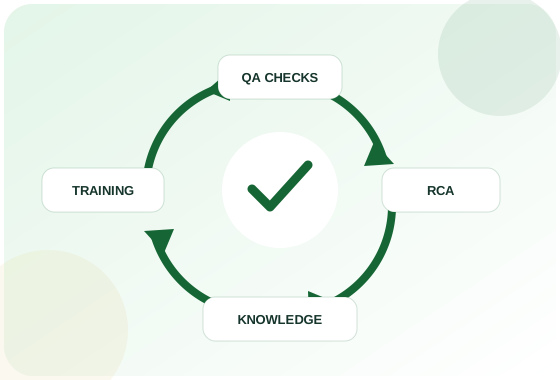
Categorized defects across human, knowledge, system, and process causes, with regular analysis and owned corrective actions.
Created a dynamic knowledge base, frequently-made-error log, annotated guidance, and retraining triggered by QA and RCA findings.
Defects were tracked by cause and addressed through training, process revision, or tool improvement.
QA, RCA, knowledge management, and training became one connected operating rhythm.
The model improved client confidence and became a reference for other campaign operations.