Define the service boundary
Completed due diligence to document scope, dependencies, risks, in-scope work, and out-of-scope work.

Case study 07 · Managed Services
A governance-led move that protected talent while improving speed and quality.
DSP product operations moved from an unsustainable third-party staffing model to a managed-service framework with clear accountability, career paths, process ownership, and automation.
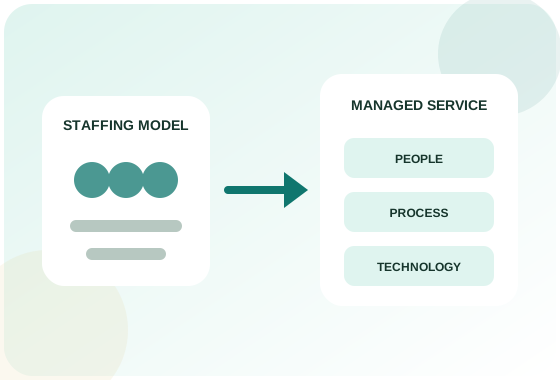
The staffing model had become difficult to govern and scale. Accountability was diffuse, talent development was limited, and the structure could not keep pace with business growth. The transition needed to introduce a true managed-service model without losing institutional knowledge or destabilizing the workforce.
The work was organized around a small number of operating choices that could be governed, measured, and repeated—not a collection of disconnected initiatives.
Completed due diligence to document scope, dependencies, risks, in-scope work, and out-of-scope work.
Built a core team spanning HR, Legal, Operations, Product SMEs, and Lean Six Sigma, supported by RACI-based ownership.
Sequenced hiring, retention, knowledge transfer, process improvement, hierarchy, and automation as linked workstreams.
Used transparent communication, feedback loops, training, and backup hiring pipelines to reduce uncertainty and protect continuity.
Ninety percent of employees were retained through the transition.
SLA timelines improved by 25% and quality scores rose by 23%.
Forty percent of manual reporting was automated and operational efficiency improved 12% within three months.